



Introduction
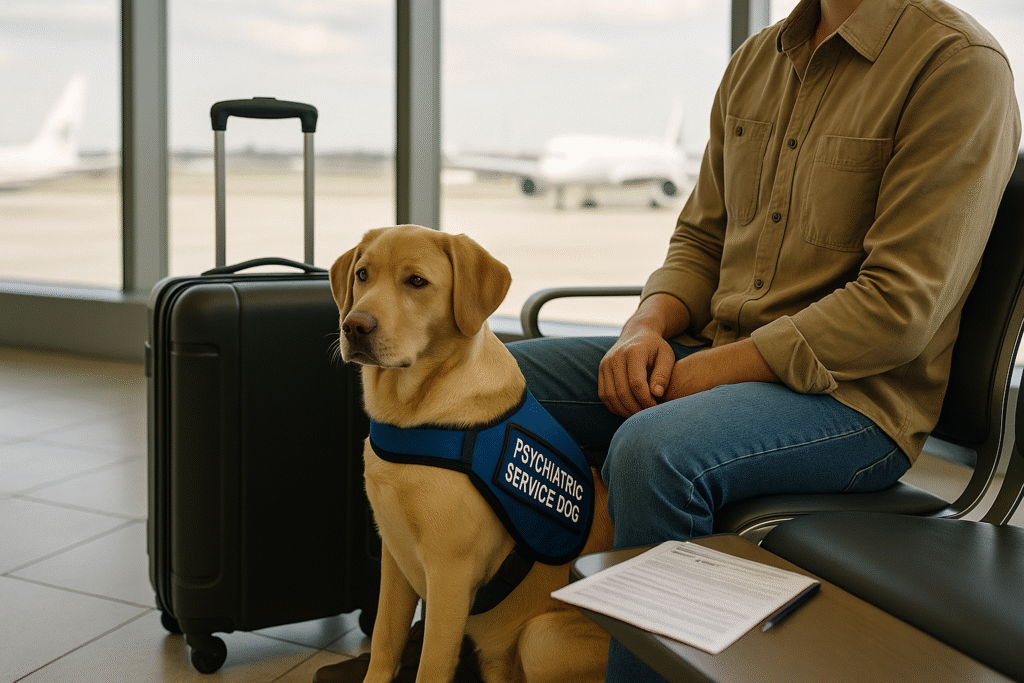
If you’ve tried flying with a service dog in the last few years, you’ve probably noticed something: airlines love paperwork.
Since the Department of Transportation (DOT) updated its rules in 2021, every U.S. airline now requires specific federal forms for passengers traveling with a service animal — even if your dog is impeccably trained.
By 2025, these forms haven’t gone away… and they’re not optional. Airlines require them to confirm that:
- your dog is trained,
- they can behave safely in the airport and cabin,
- and they won’t cause disruptions during the flight.
The good news? Once you understand the forms, flying with a Service Dog or Psychiatric Service Dog (PSD) becomes dramatically easier.
This guide breaks the DOT forms down in plain English, helping you avoid last-minute airport stress and making sure you’re fully compliant before takeoff.
🔗 Jump to a Section
- What Are the DOT Service Animal Forms?
- Who Needs To Submit DOT Forms?
- Understanding the DOT Air Transportation Form
- Understanding the DOT Relief Attestation Form
- How To Submit DOT Forms to Your Airline
- How Airlines Evaluate Your DOT Forms
- Common Mistakes Travelers Make
- What Documentation Helps (Even Though It’s Not Required)
- Do PSD Letters Still Matter?
- Sample Airline-Ready Checklist
- The Bottom Line
What Are the DOT Service Animal Forms?
The Department of Transportation created two forms:
1️⃣ DOT Service Animal Air Transportation Form (Required for all flights)
This is the main form. It confirms your dog is:
- trained to perform tasks
- under your control
- safe to travel
- housebroken
2️⃣ DOT Service Animal Relief Attestation (Required only for flights 8+ hours)
This form confirms your dog:
- won’t need to relieve itself during the flight, OR
- can relieve itself hygienically without health or sanitation risks
If the flight is less than 8 hours, you’ll only need the first form.
Who Needs To Submit DOT Forms?
These forms are required only for:
- Service Dogs
- Psychiatric Service Dogs (PSDs)
They are not accepted for:
- Emotional Support Animals (ESAs)
- Therapy animals
- Pets
If you’re flying with an ESA, the animal is treated as a pet — meaning fees, size limits, weight limits, restrictions, and carrier rules all apply.
Understanding the DOT Air Transportation Form
This is the form most people get confused about, so let’s break it down section by section.
🐶 1. Animal Identification
You’ll list your dog’s:
- name
- breed
- weight
- age
This helps airlines ensure the dog meets cabin safety guidelines.
🧠 2. Handler Information & Disability Confirmation
The form asks you to certify that:
- you have a disability
- your dog is trained to perform specific tasks related to that disability
You do not need to reveal your diagnosis.
🐕🦺 3. Training Confirmation
You must confirm that your service dog:
- is trained to behave appropriately
- can remain under control
- won’t bark, growl, lunge, or disrupt passengers
- can handle airport environments
If your dog is reactive, airlines may deny boarding — even with forms. According to the Americans with Disabilities Act (ADA), anyone may train their own service dog, so it’s perfectly legal and acceptable to put your name and number on the trainer/training organization section of this form.
🏥 4. Health & Behavior Attestation
You’re confirming your dog:
- is free from communicable diseases
- is vaccinated
- won’t act aggressively under stress
💼 5. Responsibility Agreement
You agree to cover any damage your dog causes (which almost never happens with well-trained service dogs).
Understanding the DOT Relief Attestation Form
Only required for long flights (8 hours or more).
You’ll check ONE of two boxes:
✓ “My dog can go the full flight without needing to relieve itself.”
or
✓ “My dog can eliminate in a manner that does not pose a sanitation risk.”
(i.e., using an absorbent pad in an emergency)
Most PSD owners use the first box unless their dog is medically unable to hold for long periods.
How To Submit DOT Forms to Your Airline
Each airline has its own submission process.
Here’s how most of them work:
✈️ 1. Submit Online
Most airlines upload your form into your reservation.
Examples:
- American Airlines: online submission portal
- Delta: upload to “My Trips”
- United: email + digital form
✈️ 2. Submit Ahead of Time
Airlines recommend sending forms 48–72 hours before your flight.
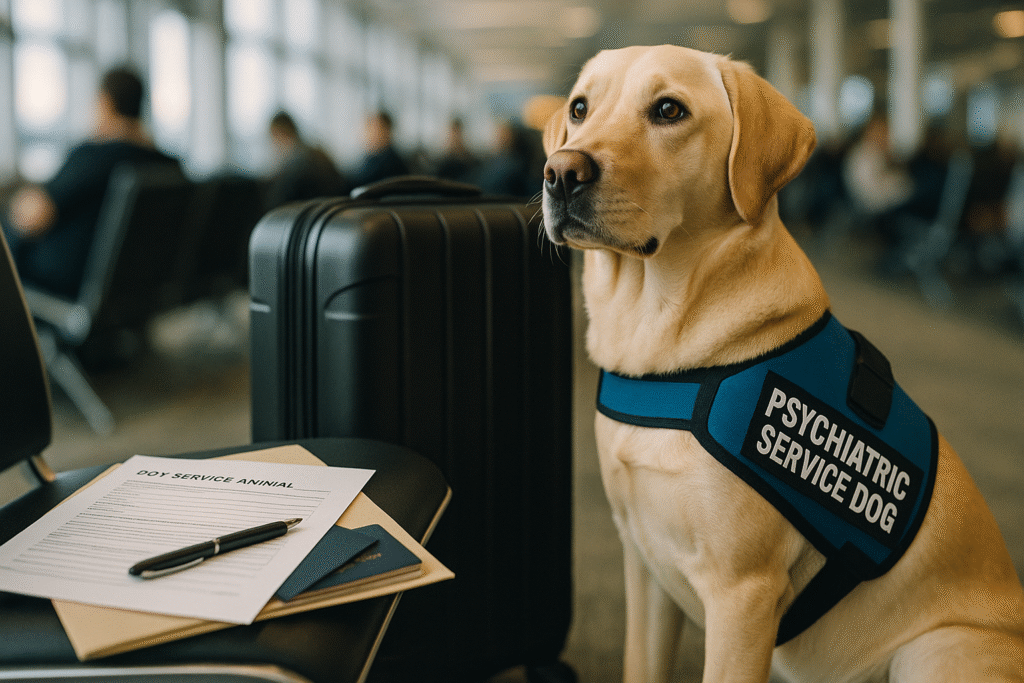
✈️ 3. Carry Printed Copies
Even if the airline has your forms on file, bring paper backups.
Gate agents often request to see them.
- Southwest Airlines requires the hard copy to be brought to the ticket counter for check-in.
How Airlines Evaluate Your DOT Forms
Airlines typically look for:
✔ Completed forms (no blanks)
One missing section can cause last-minute denials.
✔ Realistic answers
If your “2-month-old puppy” is marked as fully trained, that’s a red flag.
✔ Consistent information
Weight, breed, training confirmations — details should match your dog’s appearance and behavior.
✔ Good behavior at the airport
Ultimately, the dog’s conduct matters more than the form.
Common Mistakes Travelers Make
Here are the issues that cause the most airport delays:
❌ Submitting forms too late
❌ Forgetting the Relief Attestation on long flights
❌ Listing tasks poorly (“provides comfort” ≠ a PSD task)
❌ Flying with a dog that isn’t truly task-trained
❌ Not carrying physical copies
❌ Assuming the airline “already has it”
❌ Bringing a reactive dog
Behavior is the #1 reason service dogs get denied boarding.
Even with perfect paperwork, airlines can legally deny dogs that aren’t under control. This means verbal commands or hand signals.
What Documentation Helps (Even Though It’s Not Required)
Legally, airlines can only require DOT forms.
But practically?
Gate agents often feel more confident when you also have:
- PSD identification card
- PSD vest or harness
- NSAR registration certificate
- Training certificate or public access test results
- Vaccination record
- Vet health certificate

It’s not mandatory — but it dramatically cuts down on questioning or confusion.
Do PSD Letters Still Matter?
Yes — but not for the reason people think.
✔ Airlines do not require PSD letters
However…
✔ Housing providers do still require them
and
✔ PSD letters help validate legitimacy if airline staff asks clarifying questions
PSD letters from licensed providers (LMHPs) demonstrate:
- you have a qualifying psychiatric disability
- your PSD helps alleviate symptoms
- you receive care from a professional
- you’re not misrepresenting a pet as a service dog
This reinforces your credibility across all settings, including airports.
Sample Airline-Ready Checklist
Before every flight, confirm:
✔ DOT Air Travel Form (completed)
✔ Relief Attestation (if needed)
✔ Travel-day printed copies
✔ Dog’s vaccinations
✔ Vest, leash, harness
✔ Backup documents
✔ Dog is groomed and clean
✔ Dog is comfortable with airports
✔ Dog can remain calm under stress
If your dog is anxious in crowds, practice at home or in public spaces before flying.
The Bottom Line
Flying with a Service Dog or Psychiatric Service Dog is absolutely doable — but only if you’re prepared. The DOT forms aren’t meant to be scary or intrusive. They exist to keep passengers safe, ensure legitimate service dog access, and prevent fraudulent claims from making travel harder for those who truly rely on their dogs.
The key is simple:
✔ Understand the forms
✔ Submit them early
✔ Keep your PSD trained and confident
✔ Carry clear, professional documentation
If you need help getting properly documented — or transitioning an ESA into a PSD when appropriate — NSAR can guide you through the process with licensed providers and trusted documentation recognized nationwide.
You and your PSD deserve stress-free travel. ✈️🐕🦺
And preparation is everything.